
We hear stories like this too often while working with clients in construction or real estate development:
“We didn’t realize we needed a Project Coordinator until things started deteriorating.”
Most teams already have a Project Manager overseeing the construction project. But on larger or more complex builds, they’re often pulled in too many directions. Without a Coordinator to assist with administrative tasks and coordination on site, the Project Manager ends up buried in paperwork, responding to vendors, chasing approvals, instead of leading the project.
And often, by the time you realize you’re understaffed, the deadline and budget is already slipping.
In a survey of 505 owners in North America (202 Canadians), only 33 % felt adequately staffed for planning and design oversight. (source)
In this post, we’ll:
- Differentiate Project Manager and Project Coordinators on a fundamental level
- Help you recognize the signs when it’s time to bring in additional project support
- Set benchmarks on who to hire based on the size and complexity of your construction project
So you stay ahead of problems before they impact your bottom line.

Project Manager & Project Coordinator: The Differences
Contrary to what many would think, and although the titles “Project Manager” and “Project Coordinator” are relatively similar, the responsibilities, authority, and timing of each role are different.
If the Project Manager is the heart of a construction project, Project Coordinators serve as the central nervous system, executing and delivering crucial information to keep the entire operation functioning efficiently.
Project Manager:
High-level responsibilities:
- Ensuring that timelines, budgets, and deliverables stay on track.
- Make decisions that directly impact cost, schedule, and scope.
- Coordinate consultants, trades, and internal teams.
- Is accountable for project success.
- Main point of contact for clients and stakeholders.
Reports to:
In a development firm, they may report to a Senior Program Manager, VP of Construction or Director of Development. In a General Contractor company, they typically report to the Construction Manager or Operations Director.
Project Coordinator:
High-level responsibilities:
- Supports the Project Manager and the project team to keep timeline and documentation organized.
- Overseeing details of design evaluations and obtaining permits.
- Negotiate with suppliers, vendors and subcontractors
- Tracking change orders, organizing project files, preparing meeting minutes and booking inspections.
- Keep things moving behind the scenes.
Reports to:
Usually reports directly to the Project Manager. They sometimes support multiple PMs or report to a central project administration team.
Looking for a job description to post on your job board?
Our guide provides you with everything you’ll need to bring a job post online.
5 Signs You Need a Project Coordinator:
Even the most experienced crews and capable teams can face challenges when projects grow in complexity. Without a Project Coordinator taking on the admin and organizational tasks, a lack of focused project leadership can slow momentum and open the door to avoidable setbacks.
Here are five common signs that teams need project coordination support.
Sign #1. Your Project Manager is spending more time coordinating than leading
There’s not enough time to do it all — chasing vendors, booking inspections, coordinating deliveries, following up on paperwork. The project loses momentum fast and gets stuck waiting for instructions or decisions. Without support, the Project Manager ends up in the weeds, sacrificing oversight of progress and quality.
Sign #2. Change-order requests are scattered and not formally documented
Field-level changes are happening without proper documentation, cost tracking, or communication across the team. Without a formal change process, even minor client requests can cause delays, disrupt trade schedules, or inflate your budget.
Sign #3. Vendors and stakeholders are asking repeated questions
If you repeatedly receive requests for updated schedules, site access, or permit statuses, there’s likely a communication gap. A Project Coordinator helps centralize updates and keeps consultants, clients, and vendors informed so the team doesn’t answer the same questions twice.
Sign #4. Things are slipping through the cracks
Key decisions, dates, or changes are living in someone’s inbox, or worse, just in their head. If you say things like “I thought we already handled that” or “Didn’t someone follow up?” the risk of errors, disputes, and rework increases with every passing day.
Sign #5. Your site team is stretched beyond their role
Site Supers, Leads, and other key players are stepping in to manage administrative tasks, delivery schedules, and submittal follow-ups instead of focusing on the build itself. This is the perfect opportunity to bring in a Project Coordinator to take on the administrative workload.
Don’t know who to hire?
Here’s the best project team combination based on build size and complexity.
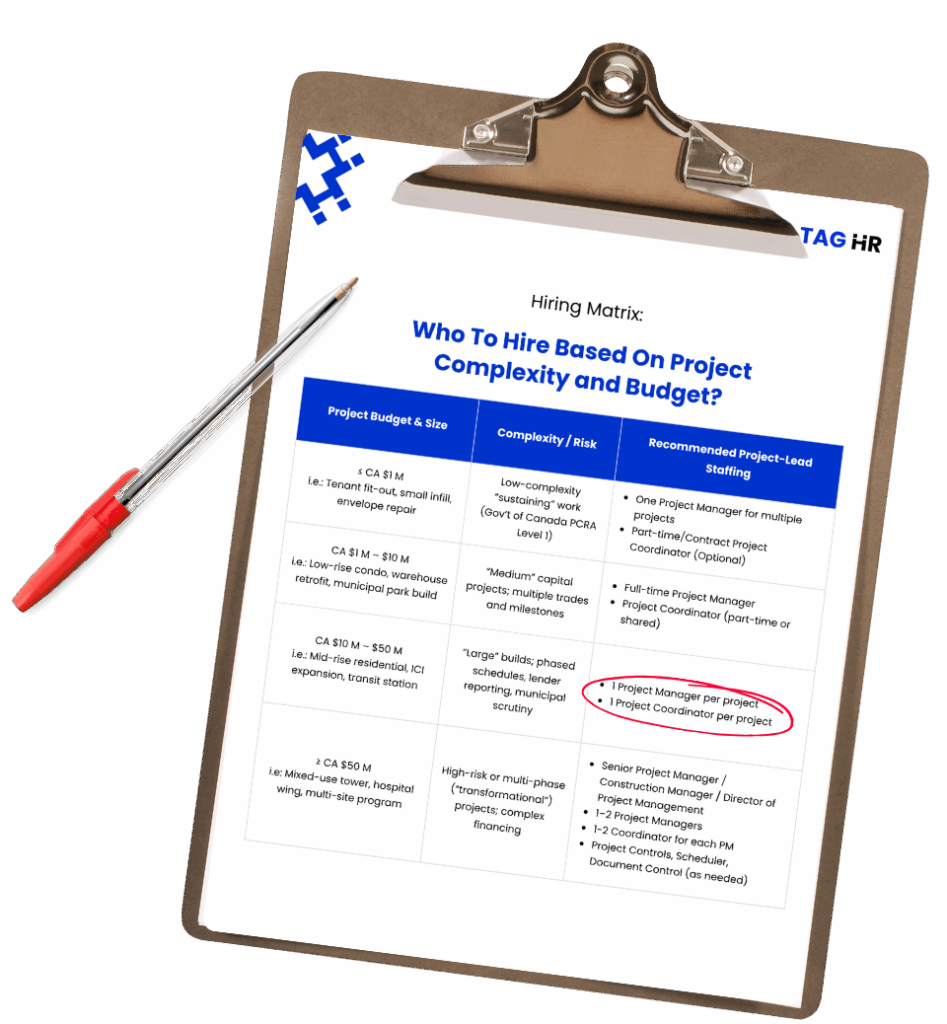
Don’t Wait for Alarm Bells
Most delays, cost overruns, and coordination failures come down to one issue: not having the right people in place when it matters most. By the time those gaps show up on your radar, you’re already feeling the consequences.
At TAG HR, we help construction and development teams plan ahead. Whether you’re mapping out the next build or mid-way through a project that’s feeling the pressure, our recruitment experts will help you identify gaps. We provide insight on timelines and compensation and handle the heavy lifting in hiring — from sourcing and screening to placement.
Your projects deserve the right support at the right time. Let us help you get there.
The right fit changes everything
Learn about our process and how we can help you find the right talent.